Posts tagged Progress
GForm validation bug PoC
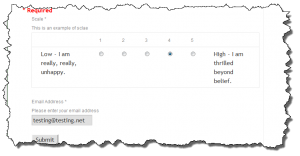
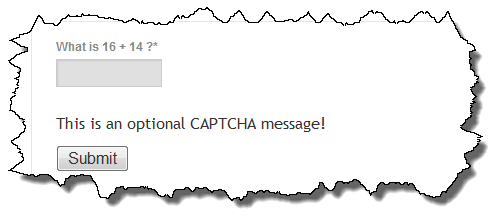
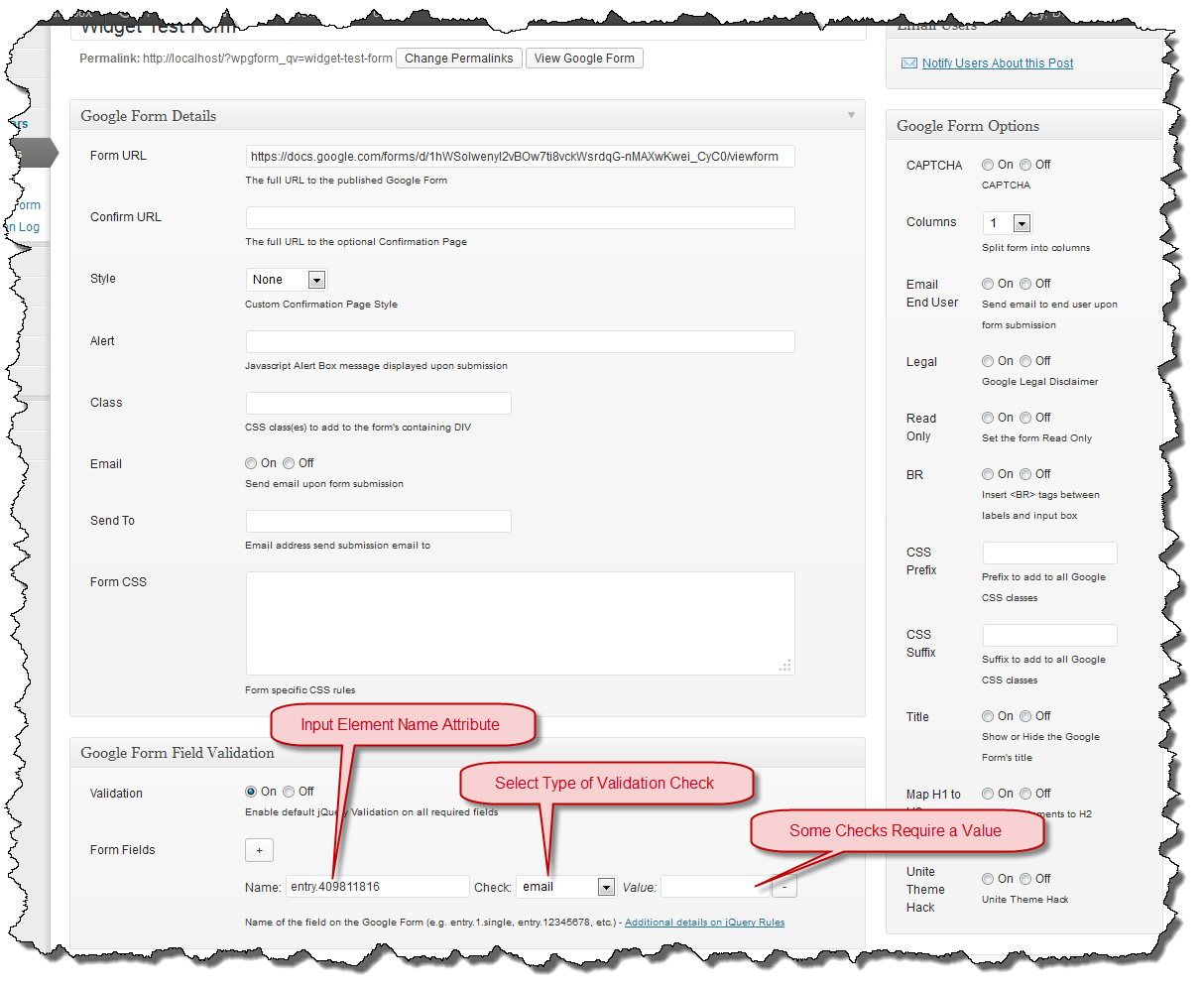
0This afternoon I spent some playing with a jQuery Form Validation plugin to determine if it will help me resolve the issue with required fields. The initial results look fairly promising as I was able to tag a couple fields on a test form and they were flagged when I submitted it.
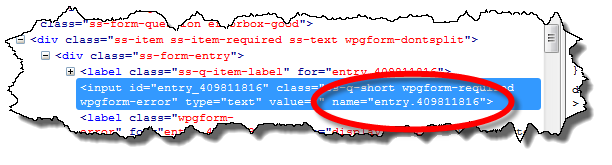
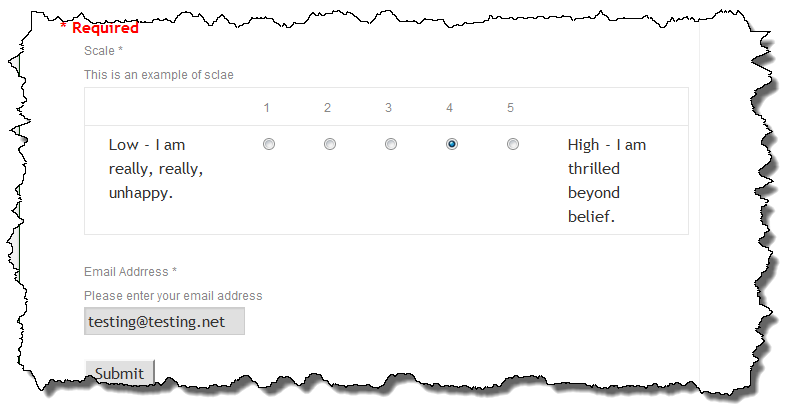
In the image above, the jQuery Validation plugin added the “Thus field is required” when I submitted the form with those fields empty. This is exactly the behavior I want, the challenge now is to scale my Proof of Concept (PoC) to work in the generic case of the plugin. The Google form defines a block for each input field and the class the denotes a field as required is assigned to one of the DIV blocks that wraps the label and form element (e.g. INPUT or TEXTAREA tag) as opposed to the form element tag itself. This makes finding the required elements a little tricky.
The real challenge I think will be input groups (e.g. radio buttons and check boxes). I need to do some jQuery research before I have a solution but assuming I can figure out which elements to select, I believe this will solve the problem with required fields.
wpGForm v0.5 fixes Settings page bug
0I have just committed v0.5 of the WordPress Google Form plugin. It addresses the problem with the Tabs on the Settings page not working correctly. It turns out that I had a couple of problems which were masked by the theme I was using. I have moved my development environment back to the stock Twenty-Eleven theme and turned off all other plugins.
By doing this I determined that the jQuery UI libraries I expected to be loaded, were in fact, not loaded at all. They were being loaded by the theme! Once I got the libraries loaded correctly the Tabs started working but they didn’t have the proper styling. WordPress doesn’t appear to include the jQuery UI CSS so I ended up loading it from Google’s CDN.
Everything seems to be working correctly now, v0.5 should appear as an update shortly if it hasn’t already.
WordPress Google Form Settings Bug
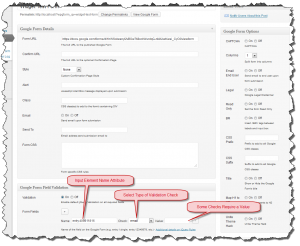
0The WordPress Google Forms settings page makes use of tabs to show information about the plugin and set its options. It appears that the theme I was using, which I am in the process developing, is the culprit. It loads some new jQuery functionality from Google’s API that apparently allowed the tabs to work as I expected. I am not sure yet why the builtin WordPress jQuery functionality isn’t working correctly as I expect it should.
Now that I know where the problem is, I think it should be pretty straight forward to fix it.
Displaying Google Spreadsheets in WordPress
0As I continue working on my School Sports project I am discovering some pretty cool stuff when it comes to displaying content on Google Docs as part of a WordPress based site. I am particularly interested in this because lots of people make lists in Excel and making lists in Google Docs is basically the same process just done via a Web Browser instead of Excel.
Our Middle School has 10 sports (6 girls, 4 boys) teams. Each has a different coach and along with one or more parents who help coordinate things like concessions, team banquets, weather updates, time changes, etc. If you’ve been involved with youth or school sports, you know how much things change and information needs to be communicated to parents and participants.
I cannot envision training 12-20 people to manage content on a web site and have any prayer of the content keeping any sort of consistent look and feel. I need a solution that is low touch (for me) but simple enough that anyone who can create a spreadsheet can keep a fair amount of content up to date.
Which brings me to Google Docs. It turns out Google makes it pretty easy to publish content from Google Docs (documents, spreadsheets, presentations, etc.) in a form that can be embedded on another web site. This will allow me to have content owners have to do nothing more than keep a couple spreadsheets up to date in order to keep the web site updated. While this works pretty well, the downside of this solution is the control over the look and feel of what Google will allow you to embed is pretty limited.
There are a couple of Google Docs plugins but it looks like Google Inline Spreadsheet Viewer will do exactly what I want. This plugin allows you to add Google Docs spreadsheets to your pages and posts using a shortcode. The resulting output has a plethora of CSS classes which means styling the spreadsheet content (which is displayed as a table) to be consistent with your theme is pretty straight forward.
The only issue I’ve encountered so far is empty cells on the spreadsheet don’t seem to be output at all, not even as an empty table cell. I think this only happens when the empty spreadsheet cells are at the end of a row of data. If there are populated cells later in the row it seems to work fine. This was a minor issue for me, one I fixed by simply populating the spreadsheet with a reasonable value.
wp-SwimTeam v0.2.488 – bug for scratches
There was a bug in the scratch process where if you started on the Meets tab when the Scratch action was selected, there was not a list of swimmers presented for the user to scratch. When starting on the Roster page and selecting a swimmer to scratch did work properly. The bug has been fixed and v0.2.488 is now available for download and both paths, starting with a meet or starting with a swimmer, now work correctly. The same bug would have affected Opt-In meets as well.
Jobs module is almost done
This past week I have made quite a bit of progress on the jobs module. Everything seems to be working, I just have some polish and testing to finish up before I will release it. The basic job work flow works like this:
- Define a job – title, description, duration, etc.
- Allocate a job to a season or to one or more swim meets. This action connects a job to a specific season or meet and defines the number of positions required.
- Assign job ownership. This can be done by either the administrator or by end users themselves. End users cannot assign themselves jobs which are already assigned to another user. An administrator can change the assignment of a job from one person to another. Job assignment can be performed in couple different ways:
- Full or Partial Season long jobs can be assigned from the Seasons tab.
- Full or Partial Meet long jobs can be assigned from the Swim Meets tab.
- A specific job can be assigned from the Jobs tab.
The Swim Meet Report has been enhanced to include a Job Assignment section and a new short code has been defined to allow a meet specific job report to be added to a page or post easily. The wp-SwimTeam demo site will be updated shortly to show some of the new features.
Export Roster to Meet Manager
If you have followed my posts on this blog you know that I have been frustrated by Hy-Tek Team Manager and Meet Manager along with Hy-Tek customer support.
While I may not care for Hy-Tek or their products, the fact is they have a dominant market share and a lot of teams use Team Manager, Meet Manager, or both. I was contacted this week by a high school coach who was looking for some SDIF assistance in getting his roster into Meet Manager. Now I don’t have access to Meet Manager but I do have pretty good understanding of the SDIF specification so I was able to help him out with some example SDIF files.
In the process of helping him out I came across an old e-mail regarding importing a roster into Meet Manager. At the time I was interested in Team Manager so didn’t give it a lot of thought. Looking at the old e-mail I realized that if it worked, I could export the file format very easily from wp-SwimTeam. I went ahead an implemented it, now I am looking for someone to try it out.
Sample Reports
The zip file above contains three versions of the same roster – CSV, SDIF (.sd3), and Meet Manager Registration (.re1). Extract the Meet Manager Registration file from the zip file. It is an ASCII file that contains swimmers records, one per line with the following fields delimited by semicolons:
- Registration number
- Last name
- First name
- Middle initial
- Sex
- Birthdate
- Club abbreviation
- Club name
- Preferred first name
- ?? – unknown what this last field is; it’s always “N” in the examples provided
To import the file into Meet Manager, follow these steps:
- Set up a new meet database. You only need to go through the first setup screen, the one where you put in the meet name, date, and length of course. To make my particular file work, select “USA Swimming” for the ID format. If you have something other than USA Swimming numbers for swimmer labels, select “Other”. Normally, for a kids’ meet, you’d select “USA Swimming” for the ID format or “Other” if you are not using USA Swimmer numbers for simmer labels.
- From the main Meet Manager menu, select “FILE”
- Select “IMPORT”
- Select “REGISTRATION FILE”
- Locate and choose the .RE1 file that contains the roster.
After completing these steps, go to the “Athletes” screen in Meet Manager. The swimmers contained int he RE1 file should bYou should see all of the athletes’ names that you saw in the RE1 file.
If this works for you, please leave a comment!
Volunteers progressing
Over the last couple of days I have finally made some visible progress on the Jobs module. I am still not wild about the term “allocate” but it is the best I have come up so I am proceeding with it.
At this point I am able to define jobs, allocate a job and quantity required against a swim meet and make some refinements of the allocation. I also have the beginning of the assignment to a specific user GUI done but not the backend functionality. I am optimistic that I may finish a first pass this weekend.
Making progress on Volunteers
Progress on volunteers has been slower than I thought it would be. It turns out that jobs, which is how I refer to the various roles that volunteers take on within wp-SwimTeam, is harder than I thought it would be.
The underlying data is fairly easy to manage but how to present the jobs, associate them with a season or swim meet, and then assign people to fill them has been a challenge. I think the reason I am struggling with this is I am not happy with the terminology I am using. There are three aspects to the Jobs functionality:
- Definition of jobs: Titles, descriptions, duration, etc.
- Allocation of jobs: Jobs are allocated to either a season or a swim meet or multiple meets. The number of positions for each job will vary. For example, the number of timers needed is dependent on the number of lanes the host pool has. You might need four timers one week and then three the next.
- Assignment of jobs: Connecting a name to a particular job. The Lane 2 timer at meet XYZ will be Betty Jones. The Announcer at meet ABC will be Tom Burns.
I am ok with the “Definition” of jobs and the “Assignment” of jobs but I don’t like the term “Allocation” but I can’t think of anything better. If you have a suggestion, drop me a comment!


Recent Comments